Mattias Jonsson, product manager Mydata software suite, Sweden
The economy and business statistics all point in the same direction: major capital investments in surface-mount equipment are on hold for the moment. As a result, many PCB manufacturers are on the lookout for smart, cost-effective tools that can boost quality and efficiency in their mount-process. This is especially true as the trend continues toward high-mix production. And yet, when it comes to the latest mounting technology, there’s a tendency to exaggerate the importance of the machines, the hardware.
One area for improvement that’s often overlooked is the software for proper and effective running of the manufacturing equipment. Not just local machine software for controlling, for instance, a screen printer or placement machine, but an overall software suite tailored and designed for high-mix production. According to experience from the shop floor, this is essential to avoid problems associated with incorrect package data, potential sources of errors and many other inefficiencies. The apparent secret lies in getting all the software linked up and working seamlessly in tandem. Users doing this can speed up changeover and production procedures.
One company that has long advocated this approach is the equipment manufacturer Mydata. While the company is primarily focused on SMD placement machines, it has long prioritized software as a key part of the entire mounting process. The company’s experience has observed that often too much emphasis is put on the machines. To get the most out of a valuable SMT manufacturing line, the users need to have a look at how control and interface software can affect the entire line – especially in a high-mix environment.
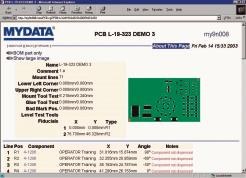
To help its clients in the high-mix environment, Mydata has introduced a manufacturing process management (MPM) software suite. Developed in-house by the company’s engineers, the suite features software innovations that are tailored to make engineering change-orders (ECO), the frequently applied changeovers and line set-ups easier. This is achieved by helping customers avoid problems associated with incorrect machine programs and package data.
This software is now being used in over a hundred plants around the globe – and the feedback the company is getting suggests some pretty dramatic increases in plant productivity. As already mentioned, software for speeding up production has always been a key focus at Mydata. It is inter-esting to note that the company was one of the first in the electronics industry to adopt Linux-based systems, with its true multi-tasking functionality. The company software with the overall suite is designed to eliminate manual data entry as far as possible, and it enables complete traceability on the shop floor as well as correct, up-to-the-minute information. Also added is a monitoring interface to help users avoid rework by catching potential errors ahead of time.
This view is shared within the company from everyone of the staff. The software suite is designed to save time and money by enabling the users on the shop floor to respond rapidly without increased costs, and by shortening changeover and setup times. Since the program is upgradeable, the user has never had to worry about starting over again from scratch.
One common drawback with such kind of software is that interfaces are not synchronized and often don’t match the produc-tion process. At first glance, this might not appear to be a problem. Nevertheless, as any engineer, operator or other users know, they quickly become apparent, particularly during shorter cycle times. For the MPM software suite, one of the key points was that it should perfectly match the assembly process. The Mydata engineers identified four key stages and wrote software packages for each of them. These are: in the pre-production phase the stages (1) data preparation, and then (2) optimization and scheduling, and during production and post-production time the manufacturing procedure itself (3), and finally performance monitoring (4).
The first stage, what the engineers looked at was data preparation. With production moving towards increasingly smaller batch sizes, there is no longer time for lengthy qualification runs nor for sophisticated fine-tuning measures in a line. Machine programs and package handling data must be accurate before the first board enters the line.
Entering of new product introduction (NPI) and transfer product introduction (TPI) data can however be a time-consuming process. This is especially true with the large variety of different CAD files, Gerber, ASCII and other formats that are being used. Therefore, the user needs software that can identify and use whatever information may be available, in whatever format. The same applies to the BOM (bill of material). When, for example, a subcontractor has plenty of customers, he needs software that can identify part numbers from any source. The software has to translate the numbers into the internal plant IT system safely. Therefore, our design aim was: identify any information, in any format.
With the right software, programming time can be eliminated. It also guarantees programming accuracy due to revision control, together with package and parts libraries that are definitely up-to-date. This way, a user is never again stressed about engineering change-orders.
The second area examined was optimization and scheduling. Last-minute changes and delayed component deliveries can bring production to a halt. So it helps to have software that can provide at least two things: maximize equipment utilization, and guide operators through the process of creating foolproof kitting instructions. Optimizing and scheduling of multiple jobs and production lines is hard enough. Processes get more complicated when there are disturbances like delayed component deliveries or late engineering changes. The built-in optimization engines handle not only feeder kitting and mount sequences, but also help operators to respond quickly to unexpected interruptions.
The program suite is flexible enough to help maximize the efficiency of personnel and equipment. For instance, software can be set to prioritize the reduction of changeover times to match staffing levels. Or work can be redistributed to maximize throughput over a number of machines or lines. Whatever a user needs, it’s the aim of the Mydata software to help customers produce more boards at the end of the day. With step-by-step changeover reports and network-based distribution, workflow becomes safer and more reliable, more efficient and virtually error-free. The program suite is also easy to use: it features an intuitive user-interface, and works seamlessly with other applications.
Manufacturing was the third stage that the programmers tackled. Users of electronic products demand continuous improvements in product quality, and at the same time, the manufacturers expect to increase their output. The software suite, based on quality-assurance strategies and such strategies as Kaizen, lean production and six sigma, aims to minimize the risk of human error while maximizing throughput.
Every error can jeopardize the manufacturing process. Take, for example, the incorrect loading of components and PCBs on a machine or the incorrect selection of a machine mount program. To help minimizing or even avoiding rework costs, Mydata’s machine operating software is designed to produce board assemblies according to specifications, every time. So, it is the manufacturing software for an ever-changing environment.
Error has been reduced in a number of ways. For instance, the operating software offers a control function for electrical verification of components before placement “on the fly“, to ensure that the components are loaded correctly. Then there is the barcode system that eliminates a manual entry of data. Even mount programs can be read off a barcode, removing the risk that a wrong program might be selected from the library. In fact, the barcode system does more than reduce the number of errors. When it is used together with the fast-loading feeder, loading and unloading times can be significantly shortened.
The software also helps to maximize output. With real-time multi-tasking capabilities, a user can perform all kinds of jobs while the machine is running to place components. This way, be it a program download, performing of backup, replenishment of a feeder or alteration of a package definition, real-time multi-tasking provides these jobs just with some key strokes.
The fourth area identified was performance monitoring. To help board assemblers improve their production process, the performance monitoring function keeps event logs and traceability data to provide a real image of a fab or line(s). The aim is threefold: helping users find the data, processing that data, and the presentation of the information in user-friendly reports. Best of all, all these tools keep the user in control throughout the entire process. With the MPM software suite, a company can handle programming and any other task off-line, from anywhere in the facility, and at any time. And without ever having to stop production.
Rework is not only costly and time-consuming, it can damage product quality and even result in missed or faulty or unreliable product deliveries. However, the right software can help manufacturers avoid potential mistakes and unnecessary costs. With the MPM suite, operators have constant access to the process lines, and can constantly track performance in real time. This makes it much easier, for example, to locate and replace a damaged nozzle or feeder ahead of time. The software also features real-time alerts that inform the operator about errors just as they occur. In addition, comprehensive tracking reports provide up-to-the-minute information on the number of mispicked components and the performance of each machine. This is particularly important in areas such as medical and automotive electronics, where traceability is a requirement. To meet this need, the MPM suite stores information in a product history file that makes it easy to retrieve information if problems arise.
When it comes to software, users want to have efficient solutions that consider the entire production line. Equipment is important, of course, but when budgets are tight, many manufacturers could boost their bottom line by doing things in an optimized way. An integrated software suite is a sure-fire way to speed up engineering change orders, changeovers and set-ups, in order to achieve higher productivity.
Anbieter von Fertigungsequipment sind mittlerweile dazu übergegangen, ihren Anwendern mit vielen Tools oder Dienstleistungen bei der Produktionsoptimierung zu helfen. Während des letzten Booms hatten viele Baugruppenhersteller, um ihren Ausstoß umgehend zu erhöhen, gleich in neues, noch leistungsfähigeres Equipment investiert, weil die Zeit für längere Optimierungsarbeiten an vorhandenen Maschinen nicht zur Verfügung stand. Nun zeigt sich, dass Produktivitätsverbesserungen mit speziellen Softwarepaketen nicht nur Stückzahlen bzw. Qualität steigen lassen, sondern auf vielen Ebenen in einem Fertigungsunternehmen für klare Vorteile sorgen.
Les producteurs d’équipements pour la fabrication ont été conduits à aider les utilisateurs dans l’optimisation de la production avec de nombreux outils et services. Au cours du dernier boom, pour accroître leur production, de nombreux fabricants de circuits avaient investi dans de nouveaux équipements encore plus performants car ils ne disposaient pas du temps nécessaire à de longues optimisations sur les machines existantes. Il apparaît maintenant que les améliorations de la productivité avec des packs logiciels spéciaux permettent non seulement d’augmenter les quantités et la qualité, mais procurent également des avantages évidents à de nombreux niveaux d’une entreprise produc-trice.
Gli offerenti di equipaggiamenti per la produzione nel frattempo offrono diversi servizi per aiutare i loro utenti con strumenti e prestazioni per ottimizzare i processi nella produzione di componenti costruttivi. Durante l’ultimo boom molti produttori di gruppi costruttivi hanno realizzato subito un nuovo investimento in equipaggiamenti ancora più produttivi, per aumentare immediatamente la loro produzione, perché non era disponibile abbastanza tempo per mettere in atto i lavori di ottimizzazione nelle macchine esistenti. Ma adesso è stato dimostrato che i miglioramenti della produttività con speciali gamme software non offrono soltanto incrementi quantitativi ossia qualitativi, bensì anche chiari vantaggi in molti livelli di un’impresa di produzione.