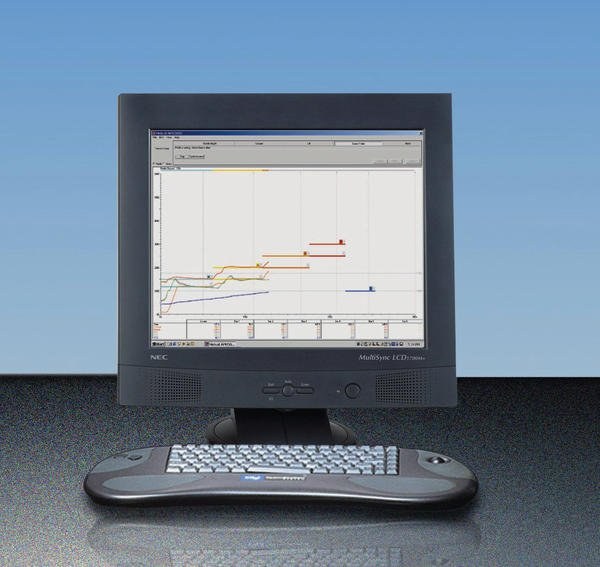
The rework system has a total of six convection heaters for underboard heating, as well as the upper nozzle for focused heating of the device undergoing rework. The revised heating algorithm now allows selected underboard nozzles to be used simultaneously with the upper heater to apply the desired reflow profile only in the area to be reworked. This saves operators setting excessive nozzle temperatures. With conventional BGA rework stations, nozzle temperatures around 300 °C can be needed to overcome the temperature gradient across the BGA package to reflow interconnects on the underside at a peak temperature between 240 °C and 260 °C. As a result, the IC lid temperature can become high enough to damage the package, the internal interconnects, or the die.
In the new algorithm, the six underboard heaters pre-heat the entire board to 190 °C. The four outer heaters are then turned off, leaving just two underboard heaters directly beneath the rework site turned on. These operate in combination with the upper heater to reflow the array interconnects using much lower nozzle temperatures than conventional rework stations. This combined heating from above and below the BGA device reduces the temperature gradient set up across the package. The peak temperature of the package can then be held below the IPC recommended maximum 260 °C, as the array interconnects reach a suitable temperature to reflow. In addition, convection air heating above and below the board enables accurate and responsive temperature control, thereby preventing air temperatures from overshooting the desired target. Temperature overshoot presents another hazard that can damage sensitive semiconductor devices. The company has received US patent approval for its dual zone convection preheater, which will deliver a fast and cost-effective solution for manufacturers seeking to improve productivity and yield when reworking double-sided, lead-free assemblies incorporating area array packages.
SMT, hall 7, booth 410 and 240/ Nepcon UK, H 11, F 46 and E 90
EPP Europe 458