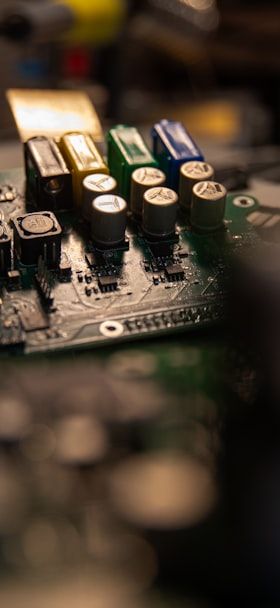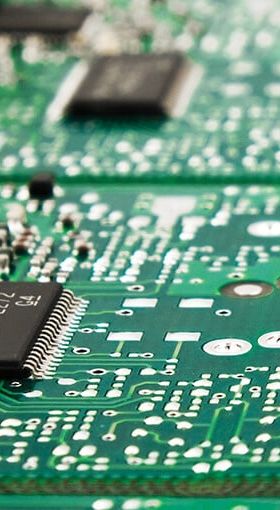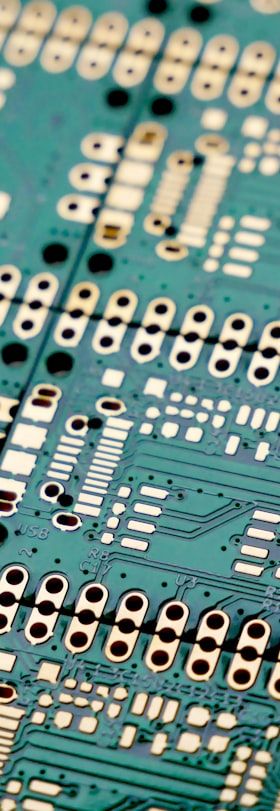
This idea was born among several companies from electronics manufacturing, machinery and device production as well as research and development. Based on extensive individual experiences, they saw the need to establish a cross-company job description for soldering techniques. The companies Hannusch Industrie-elektronik e.K., Ersa GmbH, RAFI GmbH & Co. KG and Zollner Elektronik AG recognized the signs of the times and founded the AVLE association. The objectives were quite clear: improving the quality, reliability and reproducibility of hand soldering joints.
The path to the soldering license
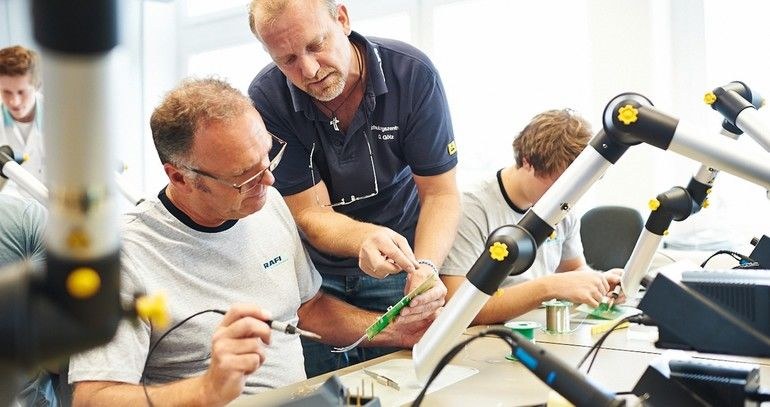
From the very beginning, the founding members were conscious of the need to provide a structured training model. Thus, a modular development program was the result. Gangolf Götz, RAFI‘s production manager and seminar director within AVLE , explains: “Module one deals with soldering principals and provides basic knowledge on the soldering of THT components (through-hole technology). Module two teaches basics on SMT issues (surface-mount technology). Module three further extends the SMT skills, and module four deals with the rework of complex components. These are the first four out of the total of eight modules.”
Professionally equipped training rooms, valuable documents and practically experienced trainers have been important in providing skill bases. The company RAFI, headquartered in Weingarten/Germany, implemented the concept and set up two seminar rooms, completely equipped with hand soldering instruments.
Approximately 250–300 soldering licenses are issued per year. In addition, there are about 150 customer-specific soldering trainings.
Automated soldering is part of the concept
Automated soldering processes are also topics in the training program. The basics and operating principles of various technologies, such as selective soldering, wave soldering, or vapor phase soldering of THT and SMT components on PCBs (printed circuit boards), are provided by means of soldering machines.
Not only system operators but managers also are “going to school”. Techniques and parameters of the SMT process are introduced and deepened in training courses specially designed for executives in the field of electronic assembly manufacturing. Mounting successfully means: all process parameters from board layout and solder pad design, via the utilization of special solder pastes and masks in temperature-controlled environments, to assembling and thermal reflow oven profile must be precisely coordinated.
ULT AG extraction system filters vapor and odors
Central fume extraction for clean air
In electronics manufacturing, millions of solder joints are processed every day. An extremely unpleasant and dangerous by-product is soldering fume. What is basically perceived as smoke, are primarily decomposition products from fluxes, soldering materials and residues of cleaning agents that combine to form sticky aerosols. These air pollutants may have significant negative impact on human health.
The capture of contaminants is regulated by law in various countries. These regulations determine risk categories for specific hazardous substances, e.g. in terms of fire and explosion risks or in types of health damaging effects (carcinogenic, mutagenic or toxic for reproduction).
In addition to coarse particles, soldering fume contains fine dusts and particulates as well as gaseous components. Within this context, one also speaks of itchy dust that occurs when the metal contained in the solder oxidizes in air. The fluxes used often tend to form large amounts of flakes, especially since lead-free solders form more solid particles than lead-containing ones. The flux contained in the solder also evaporates when soldering, the solder hardens. However, the generated vapors may be noxious.
It is not enough to exhaust contaminated air. The complete removal of occurring dusts, fumes, vapors, or odors only works in combination with according filtration technologies. For this purpose, RAFI has invested in several LRA 1200 soldering fume extraction systems from ULT AG. At the manual workstations, the LRA 1200 works as a central extraction system. The device is connected to extraction arms, which are installed at each of the twelve workstations and ensure that the soldering fume is captured at the emission source.
This fume extractor is also applied with systems for selective and vapor phase soldering as well as rework.
Proper capturing improves degree of efficiency
The efficiency of fume extraction technology is crucial. It rises and falls with the quality of pollutant capturing. Closest proximity to the emission source is essential. The formula is simple: the greater the distance, the higher the energy required. Doubling the distance to the pollutant source means quadrupling the suction power and extremely high energy consumption in order to capture the desired quantity of particles. Practical applications have proved that air pollutant are neither coarse nor fine but vary between particle sizes of 1 µm and about 10 µm. Hence, optimally developed filtration principles are required to capture and separate particles of any size.
It is the aim to convert polluted air back into clean breathing air. Therefore, all occurring contaminants must be extracted and filtered. First the coarse particles, then fine dusts, and finally gases and toxic vapors. There are several information materials, regulations and DIN specifications suggesting procedures in this context.
Within the LRA 1200 fume extractor, filtration is executed as follows: a prefilter stage first separates larger particles, thus preventing a clogging or premature saturation of subordinate fine dusts filters or particle filters. The latter work as main filters, binding the finest of aerosol drops, among others. A long filter life is important, as this results in savings in terms of energy, operating, maintenance and spare parts costs.
The main filter element is an H14 filter. Such HEPA filters (High Efficiency Particulate Air Filter) are utilized in air cleaning to provide a purification degree of 99.95 percent. They are largely applied as storage filter, fitting best for the separation of sticky dusts. Finally, an adsorption filter with activated carbon helps due to its sponge-like surface in the removal of toxic gases and vapors.
The main filter has to be exchanged once a year – an optical signal indicates saturation. The prefilters are replaced every three months on average.
Gangolf Götz is glad that the topic of air pollution as part of occupational health and safety has been taken up and summarizes: “When changing the filters, one can see what we would have in our lungs without fume extraction. You can also see the residues in the suction pipes at the workplace, which we clean every six months. By using fume extraction technology, we are able to guarantee our customers a health-conscious workplace. In our training rooms, there is a very pleasant air quality.”
Stefan Meissner, ULT AG, Gangolf Götz, RAFI GmbH & Co. KG, Manfred Frank, freelance
RAFI GmbH & Co. KG
Ravensburger Str. 128–134
D-88276 Berg, Germany
Tel.: +49 751 89–0
E-Mail: info@rafi.de
Website: www.rafi.de