Pressure range as the design basis
Pressure assisted sintering is an established joining process for die-attach connections in power electronics over the past few years. Compared to conventional soldered joints, sintering offers superior thermal and electrical conductivity, as well as significantly higher reliability in thermal and load cycling tests. However, process pressures vary considerably – depending on the paste formulation, substrate, and joining method.
The SIN 200 achieves pressing forces of up to 2,000 kN and covers the pressure range required by conventional silver sintering pastes, which can reach up to 30 MPa. For processes where pressures ranging from 1 to 20 MPa are sufficient, this level of force is not necessary – with corresponding implications for system weight, purchase costs, and installation area. The SIN 50 and SIN 100 systems are designed to accommodate this, as they are engineered for this lower pressure range.
Process pressures in diffusion soldering and reduced-pressure sintering
Two material classes define the typical scope of application for the new systems:
- Diffusion soldering (TLPS – Transient Liquid Phase Sintering): This joining method combines the workability of conventional soldering with high-temperature resistance of sintered connections. A ready for practice example on the market is the PFDS400 from PFARR Stanztechnik GmbH. This is a preform-based multilayer system consisting of lead-free tin solder and a copper layer that forms complete intermetallic phases at a process temperature of approximately 250 °C. However, the melting point of these intermetallic phases is over 400 °C. The required process pressure for the various systems available ranges from 0.4 to 5 MPa. Sintering systems that are required for traditional silver sintering pastes, are significantly over-dimensioned for this type of process.
- Recent sintering pastes: A growing number of modern formulation – including copper-based pastes and pressure-optimized silver systems – can already be processed at 10 to 20 MPa and thereby offering significant cost-saving potential compared to traditional sintering processes.
- Sintering die-attach connections of discrete devices where the lead frame geometry require only minimal force.
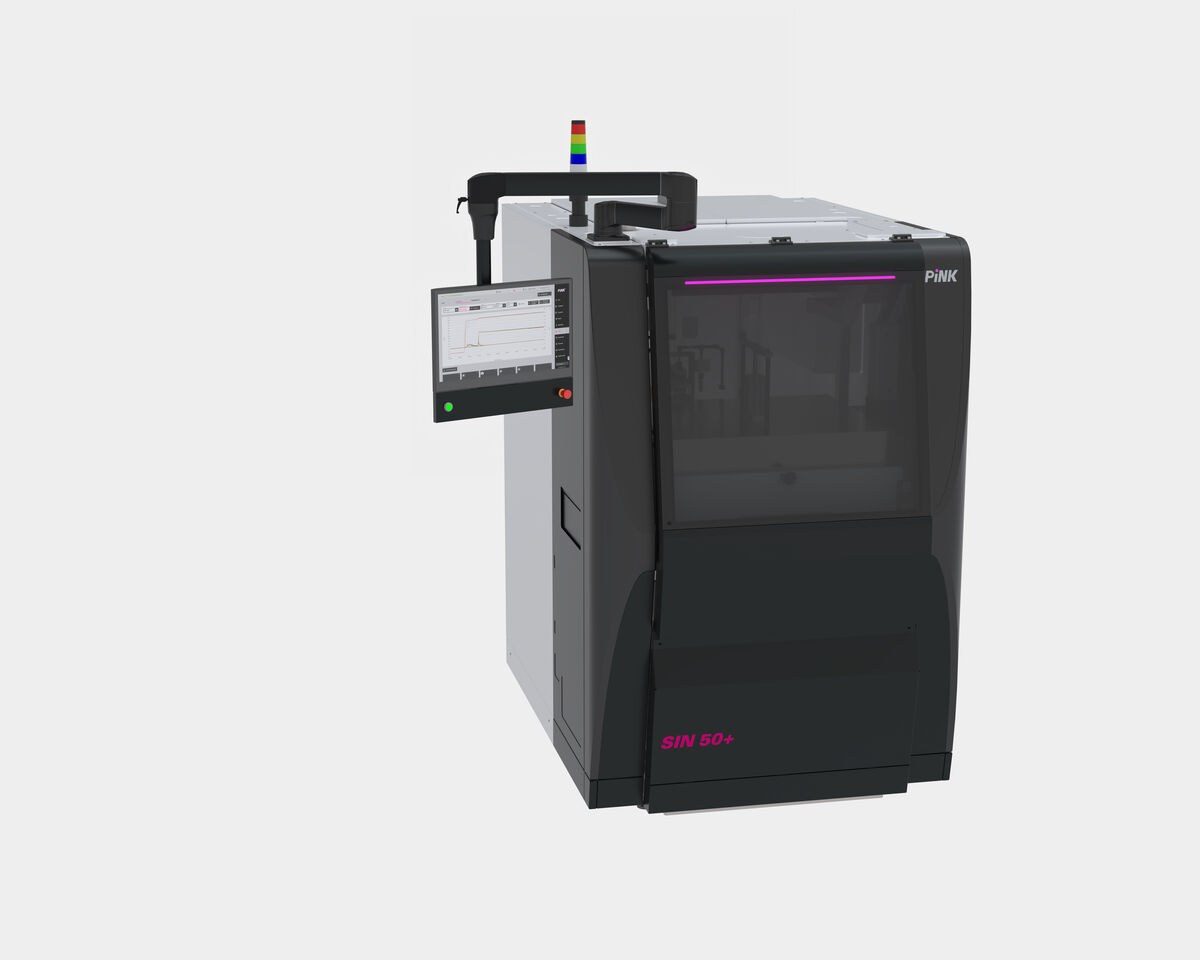
The SIN 50 covers a force range up to 500 kN, while the SIN 100 covers a range up to 1,000 kN. Both systems are designed for a maximum process area of 350 x 300 mm (105,000 mm²), which exceeds the formats currently available on the market in this segment.
Drive and process control
The drive is designed for the respective force range. Compared to the SIN 200, there is a significant reduction in the system‘s weight, as well as a corresponding reduction in the purchase price. In addition, the system’s footprint is significantly reduced; the sintering module measures 1,360 mm × 1,994 mm (width x depth) – for both the SIN 50 and the SIN 100. The lighter weight and smaller footprint lower the installation costs and simplify integration at sites with limited ceiling load capacity.
The control architecture of the sintering drive corresponds to the one of the SIN 200: Force-stroke monitoring, active force control during the process, and position control of the press stamp, are implemented in both systems. Contact force, hold time, and temperature profile are freely programmable and are recorded throughout the process.
Sintering tool concept
SIN 50 and SIN 100 are equipped with a rectangular soft tool providing the basis for two additional tool options:
- Hard-stamp tool with automatic alignment: Self-alignment compensates for parallelism deviations of the substrate and component surfaces and ensures homogeneous pressure distribution across the entire process area – which is important for close-tolerance components and when processing multiple substrates per cycle.
- Multi-stamp tool: Several independently spring-loaded stamps allow the simultaneous processing of components of varying heights on a common substrate – for example, in clip bonding. The underlying soft tool ensures even pressure distribution regardless of thickness and height tolerances. The multi-stamp attachment can be replaced by the user, allowing for quick and easy product changeovers.
The force in the tool is generated without the use of high-pressure media, neither compressed gas nor oil is used inside the tool itself. As a result, sealing and wear performance are less critical than in fluid-based multi-stamp systems, which translates into lower tool costs and longer maintenance intervals.
Both tool types are based on an elastic solid material. Thanks to its hydrostatic properties, it generates homogeneous pressure across the entire tool surface, regardless of its use as a standalone soft tool or as the base of a hard-stamp tool. Unlike gas or oil based tooling systems, there is no need for sealing elements that are subjected to continuous stress at process temperatures above 200 °C. The material is thermally stable, leak-proof and low in maintenance. In high-volume production, these characteristics have a direct impact on tool life and operating costs.
The soft tool material also has damping properties that absorb pressure spikes as the pressing force builds up. In hard-stamp tools built on top of the soft tool, the soft cushion acts as a buffer between the stamp and the component, and thereby reduces the risk of die damage as pressure builds up. This improves process reliability and yield.
Atmospheric control and temperature regulation
The available process atmospheres are:
- Vacuum technology: With optional vacuum technology, residual oxygen levels below 10 ppm can be achieved.
- Formic acid (HCOOH) combined with vacuum technology to reduce surface oxides – particularly relevant for copper-based sintering pastes and diffusion soldering
The temperature is controlled on both sides and can be adjusted independently: The bottom heating reaches up to 350 °C, and the top heating up to 250 °C. The top and bottom heatings can be controlled independently of each other. This allows for precise control of heat input within the workpiece to protect temperature-sensitive components while still providing sufficient activation energy for the sintering process.
Modularity for flexible line architectures
The SIN 50 and SIN 100 can be operated as standalone process modules or configured into an inline line with preheating and cooling modules. The chambers can be freely combined with the sintering module and an automation system and can also be retrofitted.
The SIN 50 and SIN 100 were launched at productronica 2025 in Munich. At PCIM Europe 2026 in Nuremberg, the SIN 50 was showcased alongside the latest process developments in diffusion soldering and copper-based sintering.