Ikumi Sugawara, Saki Europe
The need for bottom-side AOI came at the same time that selective soldering became more popular. A majority of the components placed on a circuit board are applied using surface mount technology. However, in the automotive industry, the circuit boards contain more through-hole parts that need soldering. Automated selective soldering equipment became popular to solder the through-hole parts on the bottom-side of the board. Bottom-side inspection was also needed after dipping and wave soldering.
Bottom-side inspection
Historically, through-hole inspection was done manually by an operator or semi-automated, often using 2D bench top systems where the PCB was inserted by hand. There was little standardization in the electronics assembly industry so there were considerable variations from process to process and customer to customer. Standardizing the inspection operation and specifications was difficult. Because the process was operator-dependent, it not only lacked accuracy and consistency, it could also result in contamination and mishandled boards. Another drawback was that the inspection process was slow. Without automation, how could the inspection process be viable?
2D and 3D automated optical inspection of the top side of a PCBA has been around for a long time. In an effort to inspect the bottom-side, some companies manually flipped the board and then placed the boards into an AOI system. While this was a way to provide quality inspection of the bottom side, once again handling and contamination problems arose. Some companies added flippers to the line, but the added step of flipping decreased throughput.
Solution for market demand
Although Saki has had equipment to inspect both sides of a circuit board since 2015, the systems weren’t designed to handle today’s larger boards and taller components. As more customers started to request a bottom-side inspection system that could accommodate these new conditions, the company looked at ways to adapt its proven 2D line-scan technology and latest AOI systems to a 2D bottom-side AOI inspection system that could solve their inspection requirements.
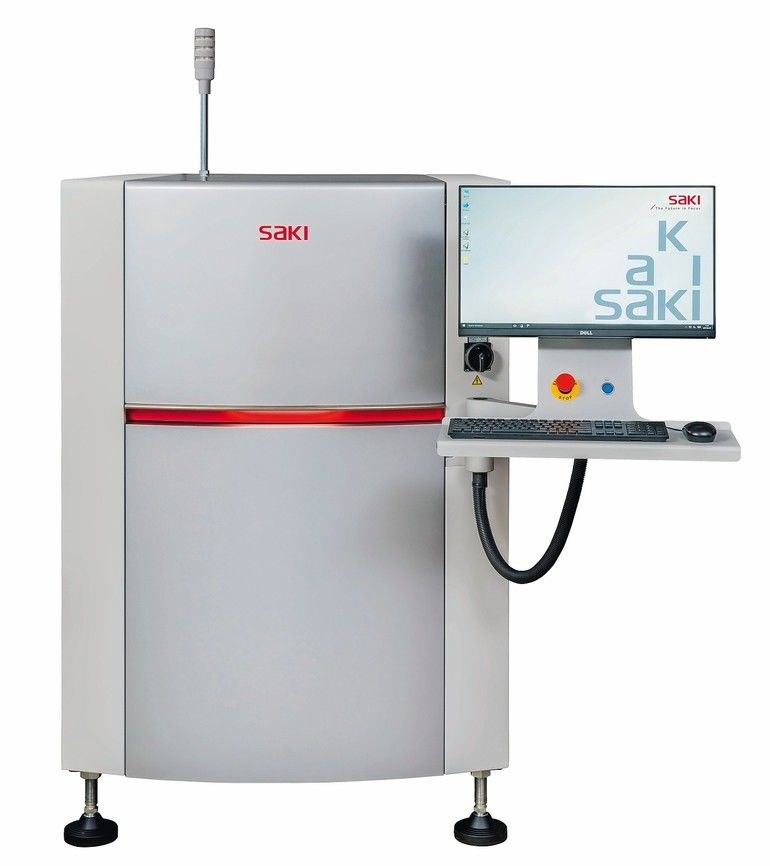
The result was the 2Di-LU1 2D automated bottom-side inspection system. It accommodates L-size 500 x 460 mm and 610 x 610 mm frames and handles tall components with clearances of 130 mm on the top side and 40 mm on the bottom. There are two different handling systems, a standard conveyor belt and a chain, and it’s equipped with space for return conveyor availability on the bottom side of the machine. The machine can carry up to 12 kg of PCB weight, which is suitable for a soldering jig frame operation.